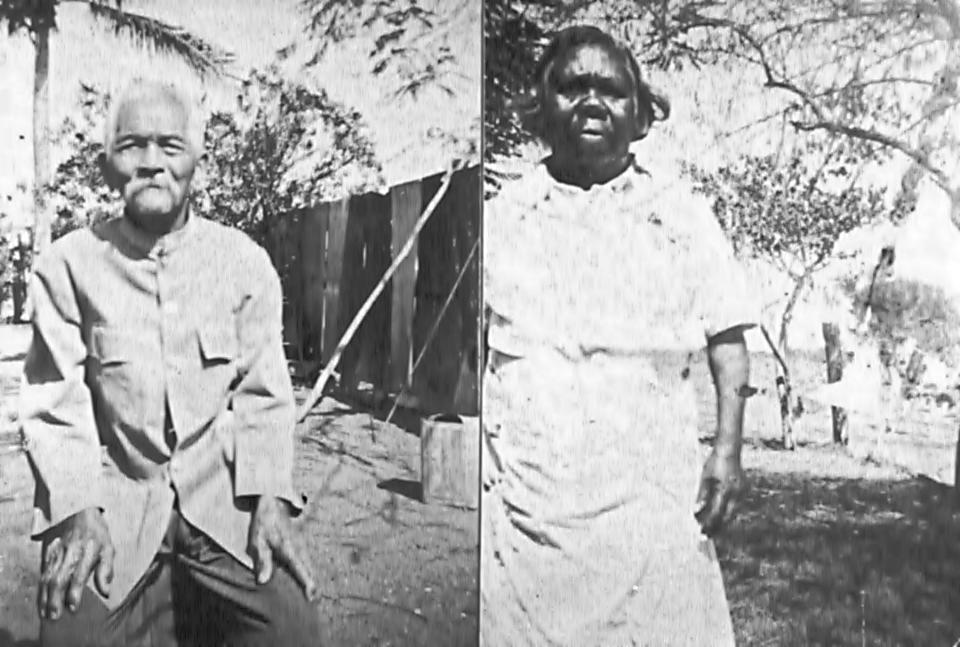
An Aboriginal Japanese family: the Shiosakis
JAPANESE GO NORTH AGAIN
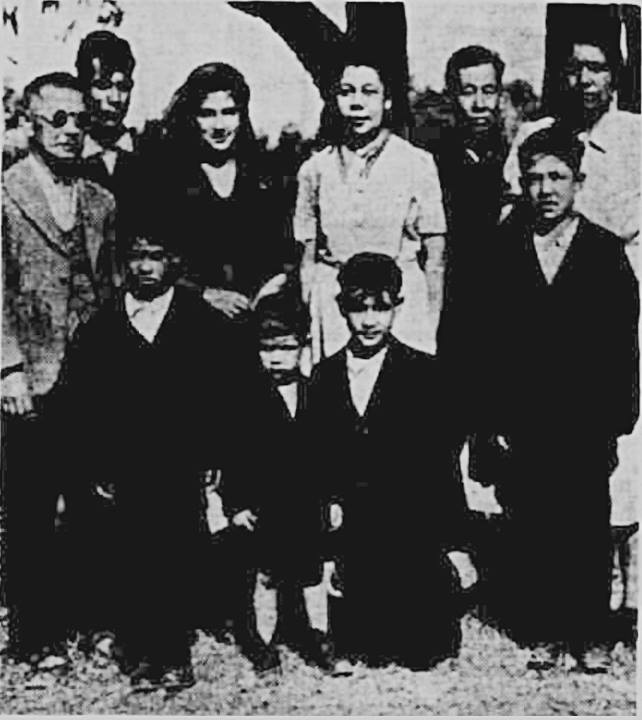
Kotsukyu Nomura, Alf Shiosaki, Stella Gibson, Peggy Carlisle, Charles Shiosaki, Margaret Shiosaki nee Beasley.
2nd Row
Cyril Shiosaki, Ronald Shiosaki, Maurice Shiosaki & Ben Shiosaki. The last daughter is Irene Nannup. (West Australian Newspaper 3.12.1946 p.8)
Unwanted Aliens: Japanese Internment in Australia by Yuriko Nagata
p.29 All the children of the Shiosaki family in Broome, half-Japanese and half-Aboriginal, went to St. Mary’s convent schooling Broome. The eldest daughter, Peggie, said: There weren’t many pure Japanese kids in the town. They were all sent to Japan. But a few went to the state school with white kids. Half-Japanese kids, like us, went to St. Mary’s with Aboriginal kids.
p.53 In November 1941, 25 women were registered as Japanese in W.A. of these were Australian-born. Margaret Shiosaki was one, and one of 5 Aboriginal wives interned in Australia. She was married to Shizuo (Charlie) Shiosaki, a Nisei J born in Broome to a J father and mother. The Shiosaki family had a laundry business in Broome. Their eldest daughter, Peggy, was 14 years old when she was interned with her parents and 6 brothers and sisters in Broome. She recalled: Dad was taken first. He was in the Broome goal. Some days later the police came to get us. Dad and the other J were going to be sent somewhere in the south. Mum was very upset and my little brothers were crying…Mum didn’t want to be separated from Dad. She chose to go (with him). Because no one in the family was left to run the laundry, they lost everything. Of the 29 J families arrested in Australia, 5 had Aboriginal-Japanese backgrounds. 3 of them were from Broome. Because Aboriginals were not regarded as British subjects, Aboriginal wives of J did not have the entitlements which wives of “white European” race enjoyed. Evidence suggests that Aboriginal wives could choose to remain home, but all five decided to go with their husbands.
p.73 On 18 January the Japanese were taken by trucks to board the “Koolinda”. On the previous day, Australian-born wives and children were taken into custody. The Shiosaki family was included. Alf Shiosaki was 10: I can’t remember exactly when, but one day I was outside with Dad and saw the aurora [sic]. dad said, “War’s coming.” And one day sometime after that, a truck came and took us…we were having lunch the, had to leave everything behind… Alf’s older sister, Peggy, also remembers the day. In her home in Derby, she said: (p.74) The policeman told us to pack up things, a change of clothes and things…We were put in a tent at the Broome goal. The goal was already packed with Japanese. We slept in the tent for one night and the next day we were taken on a ship…
Some children found the train ride across the Nullarbor exciting. "It was like having a picnic every day, seeing places I had never seen before, said Alf Shiosaki (p.75)
On 18 Feb 1942, they reached Adelaide...family groups had a short break in the Adelaide Show grounds before continuing their journey to Tatura. (They) finally reached Tatura at 8pm on 18 Feb 1942. They were exhausted. " I was very tired. All I can remember is that I just wanted to lie down somewhere, " said Peggy Shiosaki.(p.81) Alf recalled the time when he walked into the camp: “I was standing at the big gates. I think it was the entrance to the compound. There was barbed-wire everywhere. A guard patted my head and said. "Hey son, this is going to be your home for a while"(p.82)
p.158 The internees had to make many adjustments to the new climate, diet and neighbours. Most of the Japanese were from tropical to sub-tropical areas and the found the climate very different….Even in summer the temperatures were low at night. Peggy Shiosaki remembered: “It was so cold. I was all rugged up in blankets and things but still felt the cold. We weren’t allowed to use any heating.”
Children found camp life interesting. Peggy Shiosaki: “I had never been out of Broome, so that at first it felt a bit strange to see so many people who I had never met before. We lived together with people of all sorts of nationalities who had different ways of doing things. I remember the Indonesian Japanese did washing differently. They washed clothes on the table. but we had to adjust to each other”.(p.159)
Former internee children have many stories. Alf Shiosaki, 12 at the time of internment, sneaked out through the barbed- wire fence with two friends and went to a local ice cream shop: Jack and Doochi and myself…We had a few shillings…went in the shop…The man at the counter was suspicious about us and said, “Where are you boys from?” Jack was smart, you know. He said, “We’ve just arrived from Geraldton. We work sat a tomato farm.” At that moment Doochi put his head in the door. He had a typical Japanese face. At first we didn’t want to take him. But the man sold us the ice cream…We went back to the camp and the next day we had to face the camp commandant. He said, “You know those men in the sentry box. They are good shooters.”
p.160 For the children Japanese ceremonies were just occasions for eating special food. Peggy Shiosaki recalled: The party was fun. They cooked a special meal and made various sweets. The Emperor’s birthday…didn’t mean much to me. I did what others did…bowed to the sun. They (the Japanese) really did take it seriously.”
Just after the War, one authority remarked, somewhat patronisingly: Shizuo Shiosaki is an Australian Japanese born in Broome…His wife is a half-caste Aboriginal…It is difficult to see why this poor woman…who appears to be entirely Aboriginal in outlook, was ever interned with her large family. She is quite unable to understand anything of a political nature…the children show a mingling of Jap and Aboriginal blood…They are of no interest whatsoever from a security point of view and surely can never have been and it is pathetic that these children have had to be brought up in an enemy internment camp for over 4 years…
Although resident for many years in the north-west of this State, Japanese were interned for the duration of the war. Yesterday the Shiosaki family of nine and Kotsukyo Nomura (left) returned to this State by train. They will sail shortly by the Koolinda, the Shiosaki family for Broome, where they will reopen their laundry, and Nomura, a pre-war shopkeeper in Carnarvon, for Onslow to become a station cook.From left to right.
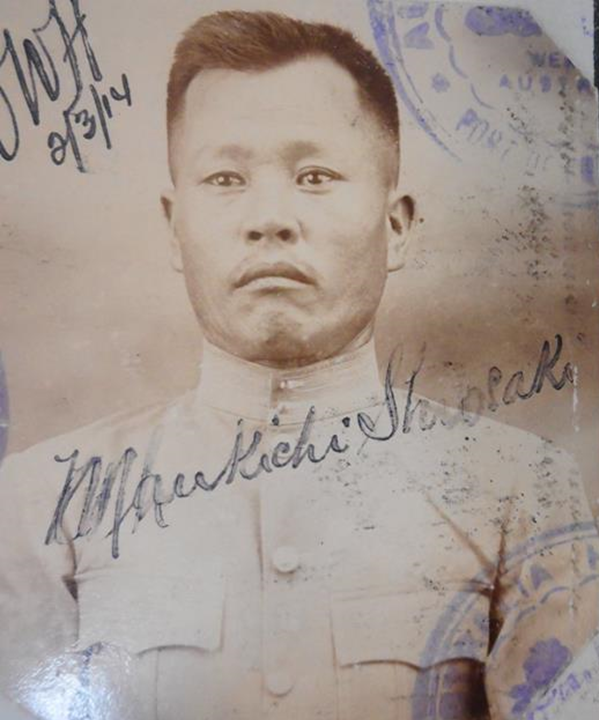
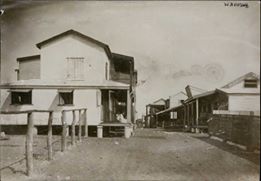
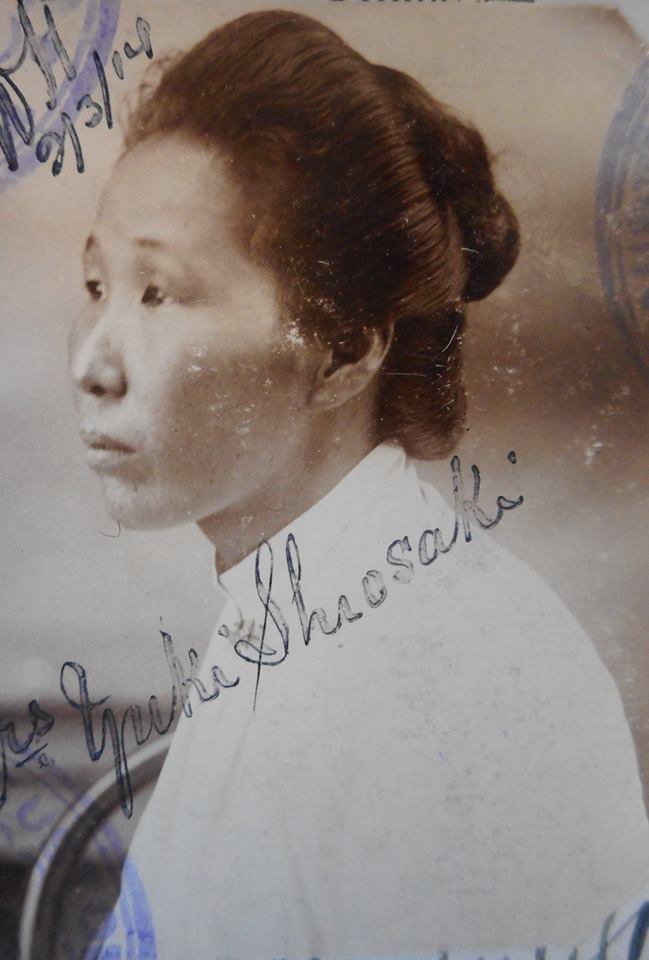
Oyuki and Manikichi Shiosaki in 1914 Centre the Shiosaki store first building on the right in Sheba Lane Broome
An Aboriginal, Filipino, Japanese family: the Matsumotos
The effects of discrimination that were brought on by the White Australia policy were not only experienced by those of Asian descent living in Australia during early twentieth century. Aborigines were treated as non‐British subjects and did not even receive the same entitlements as the ‘white’
woman.
Mary Ellenor Matsumoto nee Corpus (also known as Director of Security in Western Australia, a ‘natural‐born British subject (Aborigine), wife of a Japanese alien but reverted to British nationality’. This meant that Lena was not only affected by the Aliens Control Regulations because of her marriage to a Japanese alien, but also fell victim to the treatmentthat Aborigines had received as a result of the White Australia Policy introduced during Federation.
The concern surrounding Lena’s case was because of the preconceived attitudes held by authorities
during the early twentieth century. Authorities relied upon a report written by the Commissioner of
Native Affairs, F.I Bray.
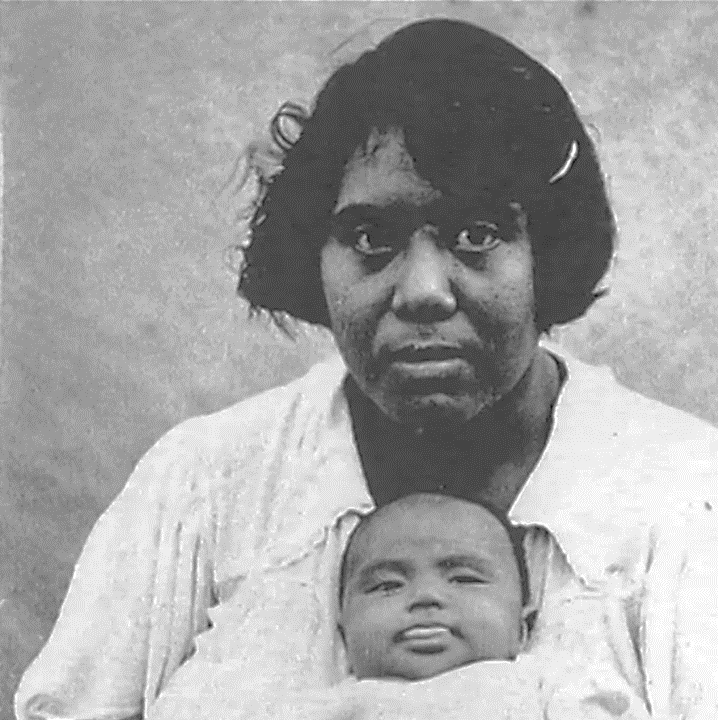

Mary Ellenor (Lena) Corpus was born in Broome. Her mother, Maria Emma Ngobing, was an Aboriginal woman born in 1884 and her Father, Sibero Corpus, was Filipino.Her mother had to register as an alien in 1944 because she married a Manilaman
In 1935 Lena was questioned about a constant visitor to the house, a Japanese indentured crewman, Matsumoto Kaiko. It was alleged that he was living with Lena, a charge she denied. Subsequently, Matsumoto left Broome for Darwin, and soon after Lena followed him there. It was discovered by authorities that Lena resided with Kakio in Darwin. In June 1938 they married in Darwin In March 1938, Kakio was charged ‘with having unlawfully cohabited’ with Lena before their marriage
on 29 June 1938. Bray, the Commissioner of Native Affairs in Western Australia expressed his dismay at the marriage in a report written to the Deputy Director of Security in Perth in July 1943:
Such marriages are unwise for social and national reasons, but evidently similar strong views were not held at Darwin, because…the Japanese was allowed to marry this native woman. Now we are faced with the aftermath. It is a very inconvenient one to the Security Authorities and since I have no place in the Southern areas of Western Australia for the detention of this woman, I can only express my regret at the unhappy circumstances and trust some suitable agreement will be made for the care of the woman and her children in the Eastern States
“The Commissioner of Native Affairs in Western Australia, in a letter to the Deputy Director of Security in Perth dated 30 June 1943, wrote: ‘A serious view is taken in this State regarding illicit (illegal) association between native women and Asiatics, especially Japanese….such marriages are unwise for social and national reasons.’”
Kakio was arrested with the other resident Japanese in December 1941. Lena and Kakio had been interned in a camp in Victoria for almost 12 months when Lena gave birth to their fourth child. Five months later when pearlers were reclassified as prisoners of war, Kakio was sent to a camp in New South Wales.
Lena's mental health deteriorated. She was incarcerated without her husband and had sole responsibility for caring for their four young children. Lena had no control over her family's living arrangements and did not know when they would be released. She had little in common with the Japanese internee, and reSpOnSIDIffly toy caring tor incur tour young WHIM). Lena naU no control over her family's living arrangements and did not know when they would be released. She had little in common with the Japanese internees and could not speak their language. She did not know why she was being held and was forced to live far from her country and extended kin. Despite recommendations from medical officers and other authorities that Lena's mental health might improve if she were sent to Beagle Bay mission (where she could be reacquainted with Aboriginal friends and family). the Western Australian Deputy Director of Security did not permit her relocation. lie argued, instead, that from a security perspective her association with Japanese people, both before and after internment. should he regarded with suspicion. He went on to note that he objected in principle to the association of Asiatics and native women and urged that Lena and Kakio's case presented a good example of the inadvisability of such undesirable unions." The Commissioner of Native Affairs in Perth concurred, advising against her relocation to Beagle Bay mission due to her marriage to a Japanese person, and because 'she would be a menace to the safety of Australia if she were sent back to the Broome area'." It is hard to imagine how an Aboriginal mother of four could pose a security threat to the 'safety of Australia'. This paranoid response to Lena's desperate situation meant that she and her children were sent further away from her husband, to a Roman Catholic mission in Balaclava, South Australia. Suggestions that Kakio's status might be changed from prisoner of war to internee - enabling Lena and her children to be interned with him at a civilian camp - also fell on deaf cars. A further measure of the white Australian paranoia surrounding alliances between Aboriginal women and Japanese men concerns the chemical testing of Lena's letters to her husband. Lena's every move was scrutinised and restricted and, perhaps not surprisingly, her condition did not improve. In 1944 she was committed to a mental institution near Adelaide and her children were sent to a convent a further 200 miles away.
The Unfortunate Story of Mary Ellenor (Lena) Matsumoto
The effects of discrimination that were brought on by the White Australia policy were not only
experienced by those of Asian descent living in Australia during early twentieth century. Aborigines
were treated as non‐British subjects and did not even receive the same entitlements as the ‘white’
woman.70 Mary Ellenor Matsumoto nee Corpus (also known as Lena), was, according to the Deputy
Director of Security in Western Australia, a ‘natural‐born British subject (Aborigine), wife of a Japanese
alien but reverted to British nationality’.71 This meant that Lena was not only affected by the Aliens
Control Regulations because of her marriage to a Japanese alien, but also fell victim to the treatment
that Aborigines had received as a result of the White Australia Policy introduced during Federation.
The concern surrounding Lena’s case was because of the preconceived attitudes held by authorities
during the early twentieth century. Authorities relied upon a report written by the Commissioner of
Native Affairs, F.I Bray. The report was written before Lena was institutionalized and highlighted
70 N. Jones, Number 2 Home: A Story of Japanese Pioneers in Australia. Fremantle: Fremantle Arts Centre Press, 2002, p.
158.
71 Copy of Memorandum from Deputy Director of Security in Western Australia to the Director general of Security in
Canberra, 30 May 1945. See ‘MATSUMOTO Nakio [Kakio] and Elina [Elener] Mary (wife) (8765) [Japanese internee] [aka
Mary Ellenor Lena CORPUS]’. K1171/1/ MATSUMOTO N, NAA, Perth.
Page | 248
concern with Lena’s association with ‘Asiatics and natives’, including her relationship with Kakio
Matsumoto. In the early 1930s, it was discovered by authorities that Lena resided with Kakio in Darwin.
In March 1938, Kakio was charged ‘with having unlawfully cohabited’ with Lena before their marriage
on 29 June 1938. Bray expressed his dismay at the marriage in a report written to the Deputy Director
of Security in Perth in July 1943:
Such marriages are unwise for social and national reasons, but evidently similar strong views were not held
at Darwin, because…the Japanese was allowed to marry this native woman. Now we are faced with the
aftermath. It is a very inconvenient one to the Security Authorities and since I have no place in the Southern
areas of Western Australia for the detention of this woman, I can only express my regret at the unhappy
circumstances and trust some suitable agreement will be made for the care of the woman and her children
in the Eastern States.72
Lena’s mother, Maria Emma Ngobing was an Aborigine and her father, Sibero Corpus was Filipino.73
Lena had three children aged from six years old to eleven months when her husband was arrested and
interned in December 1941. Lena chose to be interned with her husband in Victoria for 12 months
where Lena gave birth to their fourth child, Tatsuro Matsumoto. Five months later, Kakio was
reclassified as a Prisoner of War (POW). A POW was an enemy alien ‘transferred from overseas…[or]
captured in war zones’.74 It appears that authorities were keen to apply high security measures against
Kakio, who consequently, was sent to Hay internment camp in New South Wales, which meant that
72 Report from Commissioner of Native Affairs of the Department of Native Affairs, F.I Bray written to the Deputy Director
of Security in Perth in July 1943. See ‘MATSUMOTO Nakio [Kakio] and Elina [Elener] Mary (wife) (8765) [Japanese internee]
[aka Mary Ellenor Lena CORPUS]’. K1171/1/ MATSUMOTO N, NAA, Perth.
73 Jones, Number 2 Home, p. 159.
74 ‘Wartime internee, alien and POW records held in Perth – Fact Sheet 180’. Date Unknown.
[http://naa.gov.au/collection/fact‐sheets/fs180.aspx] Accessed:25 March 2012.
Page | 249
Lena and her children endured the separation from her husband and their father.75 Lena’s mental
health started to deteriorate and authorities recommended that she be interned with her husband:
a North West native, Mrs Matsumoto would be an unwelcome guest among the Southern natives and her
mental condition would probably deteriorate as a result...it is thought that the most satisfactory solution
would be to revert the husband to internee status...and return him to Tatura. He would then be able to look
after his family, and his presence at the Camp would no doubt have a beneficial influence on his wife.76
The issue of where Lena belonged became difficult for authorities. Director General of Security, W. B.
Simpson wrote:
This unfortunate woman has to be somebody’s problem and could not be removed to a mental institution
unless she is confirmed insane. The suggestion by the Deputy Director of Security for Western Australia that
the husband be released cannot be considered on account of his security risk and I have no intention of
returning Mrs Matsumoto and her children to an internment camp as no good purpose would be served
thereby. The status of the husband could not be changed from prisoner of war to an internee just as a
matter of convenience.77
Lena’s father Sibero Corpus was eighty four years old living at Derby, Western Australia and was
deemed ‘destitute and enfeebled…incapable of looking after her’.78 Lena’s mother and other members
of her family were living at the Beagle Bay mission near Broome. However, the superintendant of the
mission refused to admit Lena given her ‘history’ of consorting with a Japanese man and mental health.
Authorities also noted that ‘the only other native settlements are in the South. The Commissioner of
75 Jones, Number 2 Home, p. 179.
76 Jones, Number 2 Home, pp. 180 and 181.
77 Memorandum written by Director General of Security W. B. Simpson to Deputy Director of Security in Perth, Western
Australia, 25 May 1944. See ‘MATSUMOTO Nakio [Kakio] and Elina [Elener] Mary (wife) (8765) [Japanese internee] [aka
Mary Ellenor Lena CORPUS]’. K1171/1/ MATSUMOTO N, NAA, Perth.
78 Memorandum written by Deputy Director of Security in Perth, Western Australia to Director General for Security, 19 May
1944. See ‘MATSUMOTO Nakio [Kakio] and Elina [Elener] Mary (wife) (8765) [Japanese internee] [aka Mary Ellenor Lena
CORPUS]’. K1171/1/ MATSUMOTO N, NAA, Perth.
Page | 250
Native Affairs states that it would not be possible to place the family in any of these settlements for
tribal reasons’.79
Mary was not allowed to return to the Broome area because she was considered ‘a menace to the
safety of Australia’ and the Deputy Director of Security, S. Masel, reported that it was ‘illegal to
transport a native person from North of the 20th parallel of South latitude, due to leprosy reasons’.80
Lena and her children were eventually accepted at the Aboriginal station called the Roman Catholic
Mission at Balaklava in South Australia.
In May 1944, it was reported by the medical officer that Lena’s mental health was deteriorating and
that she had mistreated one of her children. It was suggested that her ‘attitude to authority and to her
co‐evacuees is so disturbing that it endangers the reasonable peace and happiness of other half‐
castes’.81 The Director General of Security in Canberra, W. B. Simpson, wrote that a medical officer
declared her insane and as a result, Mary was escorted to Parkside mental hospital near Adelaide in
September 1944. Her children were sent to a convent called the Sacred Heart at Carrieton, 200 miles
north of Adelaide.82 A short film was produced by her descendents that showed authorities informing
79 Copy of Deputy Director of Security, S. Masel, 19 May 1944. See ‘MATSUMOTO Nakio [Kakio] and Elina [Elener] Mary
(wife) (8765) [Japanese internee] [aka Mary Ellenor Lena CORPUS]’. K1171/1/ MATSUMOTO N, NAA, Perth.
80 Jones, Number 2 Home, p. 181.
81 Copy of letter from K. McEwin to W.M. McCoy Esq, 6 May 1944. See ‘MATSUMOTO Nakio [Kakio] and Elina [Elener] Mary
(wife) (8765) [Japanese internee] [aka Mary Ellenor Lena CORPUS]’. K1171/1/ MATSUMOTO N, NAA, Perth.
82 Jones, Number 2 Home, p. 184. See also ‘Half‐castes N.T. to Balaklava South Australia’. NAA, Darwin Office, Series E659,
File 1945/2493. Date: 2005. [http://mc2.vicnet.net.au/home/pmackett/balklava2.html] Accessed 5 November 2008.
Page | 251
the character of Kakio that his wife was taken to a mental institution and his children placed in a
convent.83
The investigation dossier that concerns Lena and Kakio Matsumoto is held at the NAA in Adelaide and
many documents within the dossier were expunged to the public.84 The file does, however, provide an
insight into the way Lena’s case was inappropriately dealt with by officialdom. It also shows that once
Kakio was released from internment in October 1946, over one year after the war had ended, Kakio
requested funds to assist him in his plight to reunite with his family. In a letter addressed to the Deputy
Director of Security in South Australia, Kakio wrote:
The reason for my addressing you – is to ask if you could arrange for my wife’s fare from Adelaide to Broome
to be paid by the Authorities, please. I am penniless and cannot find the money.
My wife has been [expunged], Adelaide since 19.9.44...and now there is an opportunity for her to go and live
with her sister and be looked after permanently. The question of accompanying her on the journey is
facilitated because, the Kanegae family, at present interned here are passing through Adelaide in time to catch
‘Koolinda’ sailing from Fremantle on August 16 and they could pick her up on the way.
85
The bombing of Darwin in February 1942 scarred Australian residents living in the northern parts of
Australia, therefore, due to the potential public dismay that may have followed from the return of
Japanese to Broome, Kakio’s request was denied. However, the Director General of Security in
Canberra wrote to the authorities in Melbourne, Victoria that there ‘would in any case be no objection
83 Film directed by S. Usami, ‘Kakio’s Story’. Shingo Usami/Metroscreen, 2004.
84 This file is expunged under Section 33 (1)(g) of the Archives Act, withholding information from the public ‘which would
involve the unreasonabl disclosure of information relating to the personal affairs of any person (incluing a deceased
person’. [See ‘MATSUMOTO Nakio [Kakio] and Elina [Elener] Mary (wife) (8765) [Japanese internee] [aka Mary Ellenor Lena
CORPUS]’. K1171/1/ MATSUMOTO N, NAA, Perth].
85 Copy of letter from Kakio Matsumoto to the Deputy Director of Security in South Australia, 18 July 1947. See
‘MATSUMOTO Nakio [Kakio] and Elina [Elener] Mary (wife) (8765) [Japanese internee] [aka Mary Ellenor Lena CORPUS]’.
K1171/1/ MATSUMOTO N, NAA, Perth.
Page | 252
to his wife and family being enabled to join him en route to wherever he may be relocated and fares for
the family provided accordingly’.86 Kakio and his family were eventually reunited in 1948.87 It was
published in the Daily News that Kakio was the ‘Last Jap released’ from internment. Despite many years
of incarceration and separation from his family, Kakio continued to express his admiration for Australia.
He was quoted as saying that ‘Australia best country. No friend – nothing in Japan. Japan finish 30 years
ago’.88 It was clear that Lena Matsumoto and her family had fallen victim to the bureaucratic system
that had failed many indigenous/Asian women.
86 Copy of memorandum written by the Director General of Security in Canberra and sent to Department of the Army in
Melbourne Victoria, 10 April 1947. See ‘MATSUMOTO Nakio [Kakio] and Elina [Elener] Mary (wife) (8765) [Japanese
internee] [aka Mary Ellenor Lena CORPUS]’. K1171/1/ MATSUMOTO N, NAA, Perth.
87 Film directed by S. Usami, ‘Kakio’s Story’. Shingo Usami/Metroscreen, 2004.
88 ‘Last Jap Released’. The Daily News, 20 May 1948, p. 7.
Kakio's Story is an 11 minute short film written and directed by Shingo Usami in 2004. This film is based on a true story of a Japanese immigrant Kakio Matsumoto who worked as a pearl diver in Broome, Western Australia, before the WWII. The internment of him and his Australian family during and after the war caused them tremendous hardship and grief. This film was inspired by his persistence and determination to reunite his family.
https://www.shingousami.com/kakios-story---short-film.html or
An Aboriginal Chinese Japanese Family (Source Documents)
The Chi Family
Dicky, Jimmy Jnr, Jimmy Snr, Lily and Daniel Chi
James (Jimmy) Chi
Born: Broome, 1903
Interned: Harvey (WA), Loveday (SA),
Woolenook (SA), Tatura (Victoria), 1941–46
In the late 1930s, restaurateur and taxi driver Jimmy Chi was
a linchpin of the Broome community. With his friendly, can-do
manner and multilingual ability (Wallace 2002), he moved
among the Britishers, divers, drifters and indigenous population
with apparent ease. Whether serving one of his refreshing
lemon drinks (Wallace 2002), ladling steaming bowls of his
family’s famous long soup or transporting passengers in his ’38 Chevrolet sedan, the curved chassis gleaming in the light,
Jimmy was a ubiquitous and striking personality. He exemplified the town’s diverse population and pioneering spirit more than any other.
Half-Chinese, half-Japanese Jimmy was born and raised in Broome. His father, John Chi, arrived in Australia from China as a 21-year-old ship’s boy in 1870 (Shaw 2001, p. 21). He prospected for gold in Ballarat (Nagata 1996, p. 54), then moved to Cossack (WA), where he became involved in pearling. He naturalised in 1887, before the advent of the White Australia Policy (Shaw 2001, p. 21), then found his way to Broome in 1899, where he married Yae Yamamoto. Yae was a fellow adventurer who had run away from home in Kyushu, Japan in 1896, by stowing away in the coal bunker of a ship bound for Western Australia (Jones 2002, p. 167). They had five children, all born in Broome. Although John Chi was naturalised, he was refused a pearling licence due to his ethnicity. To overcome this, he registered his luggers under the name of a white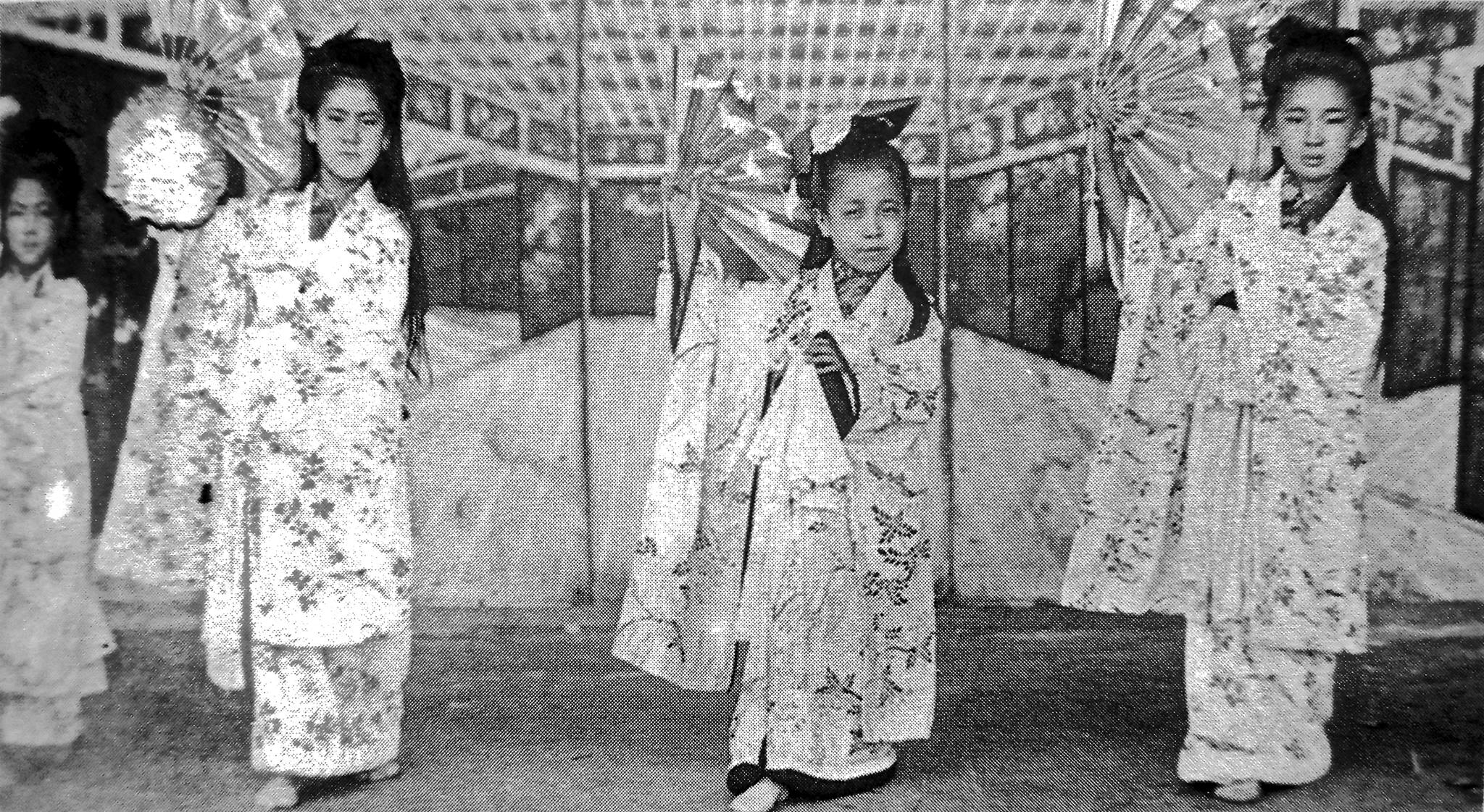
business partner, who promptly disappeared, robbing John
of most of his assets (Shaw 2001, p. 21). Chi senior gave up
on pearling and opened a long soup restaurant and boarding house in Broome. After his death in 1921 (Shaw 2001, p. 21),
the rest of the family continued to work in the restaurant.
Selina, Jimmy’s elder sister, died of pneumonia while visiting
Japan. Middle children Gertrude and Joseph both went to
Japan as young adults and found employment there. Teresa, the
youngest, married a Japanese employed at Tonan Shokai store
in Broome, then moved overseas with him, first to Indonesia,
then Japan. Only Jimmy, the eldest boy, never visited Japan.
After his mother died in 1935, Jimmy was the only member
of the clan left in Broome. Blessed with his father’s entrepreneurial
spirit, he began Broome’s first taxi service, frequently
transporting Japanese divers from place to place.
As a respected member of the community, Jimmy was often
called upon as a go-between or to help out in a jam. According
to Kenneth Wallace, a doctor in Broome from 1936 to 1939, Jimmy helped him communicate with Asian patients, and
once, when his vehicle broke down a long way from Broome,
Jimmy drove out to rescue him. ‘Jimmy Chi was a good man
in an emergency’ (Wallace 2002).
But after Japan’s entry into the war, the tables turned
against him. Although Jimmy was Australian-born and only
half-Japanese through his mother, he was arrested and interned
in December 1941. According to Jimmy, ‘The white people in
town thought I was communicating with the Japs and [that]
my brother was in the Japanese Air Force… I packed up my
stuff and they put me in gaol… I couldn’t do anything… My
wife and son were still here in Broome and my business was
just left sitting’ (Nagata 1996, p. 73).
Army records indicate he was interned due to his perceived
Japanese sympathies and the risk he posed with his Japanese
language ability and a vehicle at his disposal. ‘It is submitted
that Chi is a Japanese in all but name, and his sympathies would
undoubtedly be with the enemy. Being allowed complete freedom
of movement, the use of his wireless set and all privileges, he is
regarded as a danger to national security. His sentiments and
knowledge of the Japanese language would certainly serve the
enemy in good stead in the event of emergency. It is therefore recommended that he be interned’ (NAA: MP508/1, 255/739/490).
During the four-and-a-half years of his internment, Jimmy
was held in four different camps. Australian in his outlook,
he had trouble interacting with the Japan-born internees,
preferring to mix with other Australian-borns and military
personnel. At Woolenook camp, not far from Loveday, tensions
between the Australian-born Japanese and Japanese nationals
escalated to the extent that homemade weapons were found
in the Australian-borns’ tent (Nagata 1996, p. 175).
Jimmy was released in October 1946. He was determined
to rebuild his life in Broome, despite vehement opposition.
At a ‘stormy meeting’ at the Broome Town Hall, one person
suggested a boycott of Japanese businesses (‘Broome Objects
to Japs’ Return’ 1947). Upon his return, Jimmy found the
town a different place. His house and restaurant had been
burnt down, his taxi had been commandeered by the army
and his equipment sold (Nagata 1996, p. 226). ‘On Broome
jetty, white people yelled at me. They said, “Why did you
come back? No house to live in!”’ (Nagata 1996, p. 226).
Jimmy faced continued antagonism from many locals, the
memory of Japan’s four air raids (Nagata 1996, p. 226) no
doubt fresh in their minds. ‘…I couldn’t go out on the street.
They had meetings at the RSL hall and Shire Council. They
used to say, “Send the bastard to Japan”’ (Nagata 1996, p.
227). Jimmy was unemployed for three years and forced to
fish and collect cockles to feed his family. Broome’s Japanese
population had numbered about three hundred before the
war, but only nine afterwards (Nagata 1996, p. 227), further
compounding Jimmy’s isolation. He was refused a union
ticket, but after lodging a formal complaint in Perth, he got
a ticket and found work.
Despite the hardships he suffered, Jimmy gradually regained
acceptance within the community. He was one of the few former
Japanese internees who publicly spoke about his experiences
in the media (Nagata 1996, p. 226). He worked at the Broome
jetty until he retired. His son, also called Jimmy Chi, is a well known
composer and playwright who wrote Bran Nue Dae.
Jimmy died in his hometown in 1993 at the age of 90. The
alley where his father’s restaurant was located is still known
as John Chi Lane.
Source Material:
‘The privilege of employing natives’:
the Quan Sing affair and Chinese-Aboriginal employment in Western Australia, 1889–1934
by Victoria Haskins
In September 1921, two permits to employ Aborigines were forwarded to the Western Australian Chief Protector of Aborigines, AO Neville.The permits allowed Miss Yuanho Quan Sing of Derby in north-western Western Australia to engage the services of two individuals: ‘Bobbydol’ and ‘Roebourne Annie’. The permits had been authorised by the Resident Magistrate and local Protector of Aborigines, William Hodge. ‘Miss Quan Sing was told ... you could not grant her a permit to employ [A]boriginals’, explained the covering note, ‘but not withstanding this & the cancellation of her permit last year, she persists in her endeavour to obtain the privilege of employing natives’.1 Neville immediately directed Hodge to cancel the permits, telling him, ‘Quan Sing and his family have made numerous efforts from time to time to employ natives, all of which have been frustrated’.2
Indeed the ‘privilege’ of employing Aboriginal workers had been fought hard for by the Quan Sing family, initially by Quan Sing snr, and subsequently by his eldest daughter Yuanho Quan Sing, who was, as she would repeatedly point out, Australian- born. Tracing the long-running confrontation of this Chinese- Australian family from a remote north-western township with the racial politics of Western Australia’s Aboriginal administration offers a rare, detailed glimpse into the significance of Aboriginal employment control for constructing categories of inclusion and exclusion in the Australian colonising project. ‘Quan Sing’s affair’, as one official termed it, also highlights how local politics of race played out on the frontiers of white Australia in the early twentieth century, revealing the instability and fragility of colour-coded citizenship, and the role of ‘Aboriginal protection’ in the development of Australian citizenship in the early twentieth century.
It is a story that might be considered the most marginal of histories. Chinese people, and Asians generally, were explicitly prohibited from employing Aboriginal workers in Queensland (from 1902), Western Australia (from 1907), 1 Initials illeg, Memo to CPA, 19 September 1921, ‘Quansing – Employment of Natives’, series 2030, consignment 993, item 1939/0793, State Records Office of Western Australia. Unless otherwise stated all further references to the Quan Sing case are drawn from this file. 2 Copy, telegram Chief Protector Aborigines to Resident Magistrate Derby 20 September 1921; Copy, Chief Protector Aborigines to Resident Magistrate Derby 20 September 1921.
and the Northern Territory (from 1910); elsewhere in Australia, one looks in vain for any documented Asian-Aboriginal employment relationship amongst the detailed records of the various state bodies regulating Indigenous workers in the twentieth century. A rich body of historical scholarship on Asian- Aboriginal relationships suggests that legislation restricting Asian employment of Aborigines was driven largely by the authorities’ concern with controlling interracial sexuality and reproduction, even where other concerns, such as the desire to secure white economic advantage over Asians, or simple anti-Asian racism, were evident.3 Histories of Aboriginal labour emphasise the control and advantages these permit systems provided to white employers. However, the material and symbolic impact upon the Asian community of being denied access to Aboriginal labour by the same permit system is not considered.4 Nor have these restrictions been analysed in any depth in broader discussions of discriminatory anti-Asian policies passed from the late nineteenth century, although it has been understood that Chinese issues were central to the development of an ambiguous and contradictory legal framework for Australian citizenship.5 The popular image of the degrading, corrupting Chinese that seemingly justified such restrictions, a stereotype generally dismissed with ease by historians,6 might yet reveal more about the importance of declaring Chinese exclusion by refusing to admit them as employers of Aboriginal workers. As Claire Lowrie has recently highlighted, the evidence that Chinese people could and did employ domestic servants – both Chinese and non-Chinese – suggested to white colonists and officials that the Chinese were as capable of exercising ‘colonial mastery’ as the British. This was a threatening concept. The response was the discursive construction of the ‘corrupting Chinese master’, that worked to deny even powerful and wealthy Chinese the status of legitimate colonisers.7 Prohibiting Chinese men and women from employing Aboriginal workers pointedly and quite unequivocally excluded them from the colonial project.
The Quan Sing story does not provide much insight into the nature of relationships between Chinese employers and Aboriginal workers. The voices of the Aboriginal people are entirely missing from the archival records, while neither Yuanho Quan Sing nor any of her family expressed their opinions on the individuals they employed, or about the Aboriginal community more generally. Those who refused to countenance the Quan Sings’ employment of Aborigines also never ventured any criticism or comment on the way they managed their relationships with their employees. Yuanho Quan Sing was supported at times by local officials who commented favourably enough on her treatment of Aboriginal people she employed, but provided little detail. For these reasons it
. 3 May 1984; Evans, Saunders and Cronin 1988; Choo 1994, 1995, 2001; Ganter 1998, 2006; Yu 1999; McGrath 2003; Martinez 2000, 2006; Stephenson 2007; Lowrie 2009: 199–203.
. 4 For Western Australia see Hetherington 2002; Jebb 2002. For Queensland see Robinson 2008; Kidd 2007.
. 5 Atkinson 1995; Ryan 1995; Chesterman and Galligan 1997: 80–81; Markus 2001; Rubenstein 2004.
. 6 For instance see Ganter 2006: 78, 126; Evans et al 1988: 310–311; Stephenson 2007: 62–64, 66.
. 7 Lowrie 2009: 200–201.
is not possible to reach any real conclusions about the nature of the employer/ employee relationship in this specific case, nor understand whether, and why, Aboriginal people might have been prepared to work for this family.
The insights the story does provide are into the mentality of the government and officials, both local and in Perth, at the time, in administering policies that prevented Asian people from employing Aboriginal workers in any capacity. Insight can also be gained into the significance of the exclusions for Asian families like the Quan Sings, along with an understanding of why they, and others, might have sought ‘the privilege of employing natives’. More generally, the story of the Quan Sing affair provides an opportunity to contribute to the historicisation of Australian citizenship.8 If Asian exclusion was the flipside of Aboriginal protection,9 together these processes combined to constitute the un- excluded, un-‘protected’ white Australian citizen. uan Sing’s Affair’10
When Quan Sing snr was first charged with ‘working an [A]boriginal Boy’ at Derby Local Court in April 1908, and fined £1 and ordered to pay 18/- court costs, he was annoyed. He had, he asserted, a recently acquired and valid general permit to employ Aborigines. Suspecting malice on the part of a local policeman and the Court Clerk, Quan Sing snr wrote to the Western Australian Attorney- General to protest against the charge and to seek reinstatement of his permit. ‘[A]ll I ask for is Justice ... as is due to any Respectable Citizen’, he appealed.11
Quan Sing snr had been convicted under new regulations to the 1905 Act to make provision for the better protection and care of the Aboriginal inhabitants of Western Australia. Introduced in December 1907, these included directions that no further employment permits to ‘Asiatics’ were to be issued ‘whatsoever’, and that all existing permits ‘or agreements’ were to be cancelled, at the discretion of the local Protectors. Asians were classified as undesirable employers of Aborigines, alongside hotelkeepers, for whom permits were also no longer allowed, under the same regulations.12
The Western Australian permit system dated back to 1886 legislation that instituted a voluntary contract system for employers of Aborigines.13 In 1905 the Aborigines Act had made it unlawful to employ ‘any [A]boriginal, or a male half-
See Chesterman and Galligan 1997; Irving 2000; Dutton 2002; Rubinstein 2004; Holland 2007. Ganter 2006: 93.
Arthur Adams, Resident Magistrate and Protector, to Chief Protector, 16 October 1909. Quan Sing & Co to Attorney-General, Perth, 28 April 1908. Aborigines Department Circular to Protectors of Aborigines, 17 December 1907, Extract from
Government Gazette (WA) 20 December 1907, emphasis added. Aborigines Protection Act 1886(WA). For discussion see Hetherington 2002: 149; Crowley 1954;
Biskup 1973: 36.
caste under the age of fourteen years, or a female half-caste, except under permit’, requiring employers to produce their permits on demand to police or appointed Protectors of Aborigines.14
Nevertheless there had been no explicit racial restrictions on permits in 1905. This was despite the fact that the legislation had arisen in the wake of a 1904 Royal Commission, which had heard the then Chief Protector Henry Prinsep complain that contracts could be entered into without his knowledge, that he had no power to ‘prevent any Asiatic or European from being an employer under the Act’ nor could he ‘prevent Europeans or Asiatics allowing an [A]boriginal to enter, remain in, or reside on their premises’ (unless they were ‘European’ publicans), and indeed, that he could not ‘prevent the greatest scoundrel unhung from employing an [A]boriginal under contract’.15
The omission was even more remarkable given that the Commission had been headed by the new Queensland Chief Protector of Aborigines, Walter Roth, who had been involved with the passage of a 1902 amendment to Queensland’s Aboriginal Protection and Restriction of the Sale of Opium Act 1897 specifically excluding Chinese employers from holding permits to employ Aborigines in Queensland. As Northern Protector in Queensland in 1898, Roth had given explicit directions to local Protectors not to allow Chinese permits and had explained during the Queensland debates on the anti-Chinese amendment that without such restrictive legislation ‘my hands are forced to allow the [A]boriginals to be employed by Chinamen’.16 But perhaps the experience in Queensland, where the 1902 amendments had been a contentious matter of public discussion, and restrictions against all Asians were not able to be secured, explains the more discreet approach taken in Western Australia.17 The restrictions against issuing permits to ‘Asiatics’ were ushered in very quietly indeed, as regulations announced in the government gazette at the very end of 1907.
Certainly the regulations appear to have caught Quan Sing by surprise. After he interviewed the then Chief Protector of Aborigines, Charles Gale, on the matter, leaving with him a copy of his letter to the Attorney-General and information that others, including an Indian man and a Chinese baker, were employing Aboriginal workers, Quan Sing applied for an exemption from the regulations. This being refused, he persuaded Gale to agree he could re-engage the Aboriginal worker originally contracted to him, for the balance of the term of the contract, if
Act to make provision for the better protection and care of the Aboriginal inhabitants of Western Australia 1905 (WA).
Roth 1905: 32, 40. See Evans et al 1988: 311, 252; Ganter 1998: 16; 2006: 77. In fact reference to Chinese people, specifically, during the course of the Commission had been
limited and relatively innocuous, see Roth 1905: 53, 83, 101, 50. Ganter 1998: 16, notes Roth’s reluctance in the Queensland case to jeopardise royal assent. Other research by Ganter suggests that the 1907 Western Australian regulations may have been originally framed to restrict only Afghan employers, but extended to all Asians under the new Chief Protector, Gale, in 1908: Ganter 2006: 108.
he could find him. When Quan Sing could not re-locate his former worker Gale directed the local Resident Magistrate Adams to allow him to employ someone else instead, to Adams’ chagrin.
Six months later – no doubt when the term of his original permit had expired – the Derby police initiated proceedings against Quan Sing for the illegal employment of an Aboriginal man and woman. Quan Sing then insisted that he had been given verbal authority by both the Chief Protector and the Minister of Works, who was, incidentally, also the State Premier. Quan Sing was, however, charged and fined again. And the following day, he was charged again. Quan Sing threatened to lodge an appeal with the Supreme Court, but to his dismay both the Chief Protector and the Premier refused, awkwardly, to provide statements in his defence.
Despite being warned that he would be ‘dealt with severely’ if he came before the court again, it is evident that Quan Sing continued to employ Aboriginal workers. In February 1910 he complained of police ‘interference’ with Aborigines in his employ.
An oral history recorded by the descendant of an Aboriginal woman who was ‘washing and ironing’ for the Quan Sings, dated to 1910, provides a clue into what might have happened. The interviewee’s grandmother had told her children to play while she was working, when a ‘police buggy and horse’ appeared, and ‘two Aboriginal police boys sang out to them in their language if they like to go for a ride’:
the girls didn’t understand the meaning of that joy ride ... they were taken away forever.
They could hear my grandmother’s voice from that boab tree [the ‘Prison Tree’ in Derby, where the children were held overnight] calling out in Nyikina but they couldn’t answer.
Next morning the boat was coming in from Wyndham. ... Mum said that the last thing they can remember they put them on the train. And from there that train went straight down to the jetty. ... By the time Granny got down to the water, this old jetty, they put them already down in the cabin.18
Possibly, the children were taken in retribution for Quan Sing’s persistent defiance. However, as the removal and institutionalisation of mixed-descent Aboriginal children in the region dramatically intensified in this period,19 it is just as likely that the children were taken as part of a broader general sweep of
Speaker’s name withheld, Oral history recorded by Mary Anne Jebb, Derby, undated, pers comm (email) Mary Anne Jebb, 1 June 2010; and abbreviated version dated to 1910 in text on current display at Old Derby Gaol Interpretative Centre, Derby, ‘Under the Act’, nd; see also transcribed version, Dunnybudgies, ‘derby gaol’, 13 February 2002, <http://www.kuramancreative.com/dunnybudgies/states/derbygaol.html> accessed 28 May 2010.
Haebich 2000: 242; Choo 2001: 151–152.
child removal in the area. Indeed, it would have been more remarkable if they had not been taken. Whether the mother had been targeted specifically because of her employer, or a blind eye had been turned to Quan Sing’s employment of her, Quan Sing’s demand for an investigation into the removal of her children would have antagonised the local police.20
Towards the end of 1910 Quan Sing wrote once again to Gale, asking for the recovery of his permit to enable him to employ ‘a native woman to assist’ his wife, who was due in a month to give birth to their seventh child. All of their children except one infant were at school and when the new baby arrived it would be a ‘necessity’ that his wife had help in the house.21 His request was refused. In September 1911, however, Quan Sing had managed to secure a permit, from a new, apparently sympathetic Resident Magistrate, named Gurdon, at Derby. By the end of the month, the police at Derby had reported this breach of the regulations, and under instructions from the Aborigines Department Gurdon was forced to cancel the permit.
In April 1913, Quan Sing wrote again to the Attorney-General requesting a permit to employ someone to assist his wife, ‘as it extremely hard for her to do the whole of the washs the single hand with so many childrens (7 childrens) after my elder daughter to go to the Claremont Methodist ladies college’.22 Again, refused.
In September 1915, some months after the appointment of a new Chief Protector, AO Neville, Quan Sing called on his offices in Perth to ask if the ‘boy’ he had previously employed could be returned to him, and again, some seven months later, to point out that two hotelkeepers, an Indian man and a Chinese baker all employed Aboriginal workers in Derby, and to request a general permit. Quan Sing’s efforts resulted in a desultory investigation by Neville into his claims but, once again, a refusal to provide him with a permit.
It was at this point that Quan Sing’s daughter, Yuanho Quan Sing, made her first application for a permit to employ ‘[A]borigines womens’ in August 1917. She explained that as she was born in Derby, she understood that she was entitled as a ‘natural born British subject’ to such a permit, and she asked the Protector to ‘oblige’ her ‘to have fair place same as anybody in Derby’.23 The current Resident Magistrate at Derby, a man by the name of Elliott, sent an anxious telegram to Neville pleading that he not grant her a permit, as it was just a subterfuge by her father and would create a ‘lamentable precedent’. It seems the police in
In the end, the Police Investigator only recommended that Quan Sing should see the Chief Protector Gale about the matter, according to Quan Sing: annotation, WO Sallenger to Quan Sing, 28 March 1910.
Quan Sing to CF Gale, 5 November 1910. Quan Sing to Attorney General, Perth, 14 April 1913. Miss Y Quan Sing to the Protector of Aborigines, 27 August 1917.
‘THE PRIVILEGE OF EMPLOYING NATIVES’
Derby were threatening to prosecute Quan Sing, yet again, for employing an Aboriginal worker at this time, and Quan Sing had engaged a solicitor’s firm to forestall them.24 Yuanho Quan Sing’s application was refused.
Yuanho Quan Sing’s response was defiant. Pointing out as her father had done that others were infringing the regulations in Derby, she again requested a permit, and was again denied. In October the following year, she was given a permit by Sergeant Crowe of the Derby police, which Neville immediately directed be cancelled. However, at the end of 1921, when Neville ordered the newly arrived Resident Magistrate Dr William Hodge to cancel the two single permits he had issued to Yuanho Quan Sing, he would encounter unexpected resistance.
A natural-born British subject
The argument that she was entitled, as a British subject, born in Australia, to employ Aboriginal labour, was at the centre of Yuanho Quan Sing’s case for a permit, and it would be this argument that would perplex and indeed divide the authorities. That it was an argument her Cantonese-born father could not have made was not lost on Derby’s Resident Magistrate, Elliott, who considered her application a ploy by her father. Nor was it lost on the authorities in Perth. The Aborigines’ Department sought advice from the Solicitor-General of Western Australia, who replied that while the grant of a permit was ‘discretionary’, it was definitely not to be granted to an ‘Asiatic’. Although there was no definition of ‘Asiatic’ as such, ‘the question does not turn on whether the applicant is a British subject or naturalised’. At any rate, he opined, ‘I think a person born of [C]hinese parents should be deemed an Asiatic’. And finally, given that her father had been refused a permit, ‘I do not think it should be issued to his daughter living with him’.25
Quan Sing snr had protested to the Attorney-General at the time of his first conviction that he had been a ‘respectable resident of Derby since 1889’ and as an employer of Aborigines under permit every year since, he had ‘never been subjected to such annoyance before’.26 His application for an exemption from the regulations set out his respectable status as an importer and merchant. He was a ‘married man residing with my wife and six children’; had been a ‘law abiding resident’ since his arrival in the colony; and could provide character references from ‘leading Government officials’ at Derby.27 His application was probably made on the advice of the sympathetic Chief Protector Gale, who forwarded it to the Colonial Secretary with a covering note pointing out that: ‘These regulations
Telegram, Elliott to Chief Protector Aborigines, received 24 September 1917; Memo, Secretary to Chief Secretary, 25 September 1917.
Solicitor General, Western Australia, memo, 29 September 1917. Quan Sing & Co to Attorney-General, Perth, 28 April 1908. Quan Sing to Chief Protector of Aborigines, 4 June 1908.
were made to prevent Afghans encouraging native women about their camps, it was never meant to apply to a respectable married man with a wife of his own country.’28
An exemption constituted no threat to the new system, but on the contrary, endorsed the power of the authorities to decide who could and could not be permitted to employ Aboriginal workers. While Quan Sing’s application for exemption was refused by the Colonial Secretary, it seems Gale was able to manoeuvre a limited kind of informal permit for him anyway – much to the aggravation of the local Resident Magistrate at the time. As the course of the Quan Sing story makes clear, the way the system functioned allowed local authorities a degree of latitude in their discretion to both dispense permits and to turn an unseeing eye where they chose. Having suspected local malice from the outset, Quan Sing’s refusal to defer to the local police and officials unsettled the usual method of regulating Aboriginal employment. His repeated insistence that other non-white employers were being allowed Aboriginal workers in Derby – what Magistrate Elliott would describe with annoyance as his ‘idle carping’29 – resulted, eventually, in Neville asking Elliott for a report on ‘Asiatics’ employing Aborigines. Elliott’s response is fascinating for the insight it provides into the operation of the permit system at the local level.
Elliott denied knowledge of any Asians employing Aborigines in the West Kimberley. He stated he had only issued permits to those who applied through the Derby police, and were recommended by them as ‘fit, and proper persons to employ Natives’. The Indian man whom Quan Sing alleged employed Aborigines to drive carriages was Joseph Griffiths, government contractor and wood carter. He was, Elliott informed Neville, born in Barbados, and therefore a British subject, ‘entitled to all the privileges of a Britisher’.30
Elliott’s response highlights the contemporary understanding that being born in a country under British rule conferred all the rights and ‘privileges’ of British status. No doubt this would have been salt in Quan Sing’s wounds. Three years earlier he had lost a different (though related) battle, when the local Derby court refused his application for renewal of his license to sell liquor on the grounds that legislation passed in 1911 disallowed the issue of such licenses to any person not a ‘naturalised British subject’. Quan Sing had taken the case to the federal authorities, claiming to be born in Hong Kong and thus a British subject, but as he could not produce a birth certificate, and had given his birthplace as Canton on all his children’s birth certificates, the license was not granted.31
. 28 CF Gale to Under Secretary, Colonial Secretary’s Department, 11 June 1908. See footnote 17.
. 29 F Elliott to Chief Protector of Aborigines, 20 September 1916.
. 30 F Elliott to Chief Protector of Aborigines, 20 September 1916.
. 31 ‘A Chinese Puzzle: The hard case of Quan Sing’, The Advertiser (Adelaide), Friday 25 July 1913:
But Elliott’s spirited defence of Griffith’s permit went further. Clearly, the right to employ Aborigines was a measure of acceptance and inclusion in the white community, at the local level as much as at the state. Griffiths was, admitted Elliott, ‘what you would term a Colored Man’, but ‘not necessarily ... an Asiatic’:
Color cannot be the line of demarcation in his case, and I would remind you that, that Great and Good Man who lived some two thousand odd years ago Jesus Christ was a colored man, but no one has ever presumed to dub him an Asiatic. Moreover I can assure you, that if a petition were got up on his behalf, it would be signed [illeg] by all the inhabitants.32
Quan Sing’s claim that the Chinese baker, Ah Chee, employed an Aboriginal woman, was never directly addressed. Elliott’s denial of any knowledge of Asian employers suggests that this employment was carried out without a permit, but tolerated nevertheless. As Ganter observes with regard to the Northern Territory, there ‘had always been exemptions to the rule of Chinese exclusion from employing Aborigines’,33 but it was not only a matter of formal exemptions – evidently, the employment of Aboriginal workers by both hotelkeepers and Asian employers was a hazy part of the everyday reality of life in north-western Australia, and tolerance depended very much on the sympathies of local authorities.
Yuanho Quan Sing’s determination to acquire a permit must be seen in this context. The regulation of Aboriginal employment was clearly being utilised to structure a tiered social order. By asserting her rights as a ‘natural born British subject’, Yuanho Quan Sing was both claiming her ‘fair place’, and challenging the power of the authorities to decide where she should be located. Indeed, in her first letter to Neville she stated that hotelkeepers in Derby were circumventing the permit system by organising associates to take out permits on their behalf, and that her father’s friends were prepared to do the same: she ‘trust[ed]’ he would not object to this, but would ‘oblige our [family] as same as you oblige everybody at Derby’.34
On learning she was not to be given a permit, Yuanho Quan Sing then sent a carefully worded letter by registered post to Neville:
I desire to bring under your notice the following clause which I have noticed in the Aborigines Act, reading viz “No permit is shall be granted for employment of any [A]borigines or any half caste under the age of fourteen or female half caste to any premises licensed for the sale of intoxicating liquor.” and wish to point out to you that practically all the licensed premises here have been and are still employing [A]borigines contrary to this clause.35
. 32 F Elliott to Chief Protector of Aborigines, 20 September 1916.
. 33 Ganter 2006: 154.
. 34 Miss Y Quan Sing to the Protector of Aborigines, 27 August 1917.
. 35 Y Quan Sing to Protector of Aborigines, Perth, 10 October 1918 (original emphasis).
The Department ‘must have overlooked’ that particular clause, she continued, or have ‘allowed an infringement of the Act for Derby’. Therefore, she argued, the Department ‘should also allow an infringement of the clause referring to my case & grant permit to me to have the matter justified’.36
Rejected again, Yuanho Quan Sing wrote to Neville in May 1918 declaring that every hotel and wine shop, as well as ‘other Chinese premises and gardener’, had been employing Aborigines for both ‘inside’ and ‘outside’ work. ‘Now I will also ... employ Aborigines as same as everybody in the town ... I trust that you will not objection [sic]. Now I beg to ask you to protect me same as everybody’.37 Neville replied that he regretted he was unable to comply with her request.38
It is clear that Neville considered the advice the Department had received from the Solicitor-General in 1917 an unshakeable rebuttal of any claim that Quan Sing’s daughter might make as a ‘natural born British subject’, and he clung tenaciously to the notion that the categories of ‘Asiatic’ and ‘British subject’ were mutually exclusive as his justification for refusing to consider her application.
But not all would find the reasoning compelling. Late in 1920, the Police Sergeant at Derby, WS Crowe, decided that Yuanho Quan Sing was indeed a fit and proper person to employ Aborigines, and informed the Chief Protector he had issued her with a permit. Neville explained, in a tone of weary patience, that ‘many’ applications ‘by this girl and her father’ had been refused, and the Crown Law department had ruled that ‘these people were deemed to be Asiatics within the meaning of the law and the Solicitor General said that if a permit had been refused to Quan Sing he did not think it should be issued to his daughter’. He informed Crowe that the permit had to be cancelled. At the same time, interestingly enough, Neville mentioned that he had directed the Resident Magistrate to cancel a permit issued to a Nellie Ah Chee at Derby: the Ah Chee family were the bakers to whom Quan Sing snr referred in 1908 and again in 1916.39
It would seem that Yuanho Quan Sing had decided to make her application through Crowe, evidently a newcomer, and had spent some time making her case. ‘Miss Quan Sing was born in Derby WA and is therefore a natural born British Subject and is recognized as such & her name is on the Commonwealth & State Electoral Rolls & she votes at every election’, Crowe replied. ‘The Aboriginal Natives she employs are well treated and should you desire me to cancel the permit please let me know on what ground as Miss Quan Sing will
Quan Sing to Protector of Aborigines, Perth, 10 October 1918. Miss Y Quan Sing to Chief Protector of Aborigines, Perth, 16 May 1919. Copy, Chief Protector of Aborigines to Miss Y Quan Sing, 29 May 1919; copy, Chief Protector of
Aborigines to the Resident Magistrate, Derby, 29 May 1919. Copy, Chief Protector of Aborigines to Officer in Charge, Police Station, Derby, 29 October 1920.
take the matter up’.40 Neville was resolute, insisting that while ‘the regulation continues in force, no Asiatic whatsoever should receive a permit’,41 and Crowe complied with his orders.
The newly arrived Resident Magistrate, Dr William Hodge, who granted two individual permits to Yuanho Quan Sing at the end of 1921, was less amenable. Neville had forwarded copies of his previous correspondence with Crowe when directing Hodge to cancel these two permits, but Hodge took exception, retorting that he failed to see how the Solicitor-General’s reading of the law applied to Miss Quan Sing. The dictionary definition of ‘Asiatic’, Hodge told Neville, was ‘one that is born or belongs in Asia’. Miss Quan Sing was born in Western Australia and had never been out of the state in her entire life, ‘and therefore is not an Asiatic’. She had the vote in both federal and state elections ‘as an Australian citizen by right of birth’. Indeed, he went on:
If Miss Quan Sing is to be counted an Asiatic because her Parents were Asiatics there is no Australians except perhaps the Aboriginals as if the children born in Australia take the Nationality of their parents they would all be Europeans Africans or Americans.42
Neville forbore from engaging with that line of argument, instead retreating to the line he had taken previously: that he was bound to observe the ruling of the Crown Law authorities, and so it was ‘not possible ... to sanction employment of natives by the Quan Sing family’. Informing Hodge that the previous Resident Magistrate had been ‘very much averse to granting such a permit’ and had said it would ‘create a lamentable precedent’, Neville tried to persuade Hodge against sanctioning Chinese employment by slyly calling him on side against the race. ‘Quite apart from the legal aspect’, he coaxed, ‘it is most undesirable that any association be permitted between Asiatics and Aborigines. This Department is constantly meeting trouble which arises through such association, and it was for this reason that the Regulation was instituted in the first place’.43
But Hodge would not have it. ‘The ruling of the Solicitor General does not touch on the point of Australian born persons of Asiatic parentage’, he wrote back. Children of all other nationalities born in Australia were Australians, Hodge insisted, and the children of Quan Sing were Australian by birth also. Refusing or cancelling Miss Quan Sing’s permit would set a much more lamentable precedent ‘of injustice’ – ‘Dont admit Chinese if you dont like them [sic]’, he snapped, ‘but if admitted give them justice’. ‘I have not cancelled this permit nor do I intend to do so’, the Magistrate continued.
WS Crowe, Sergt S/C Protector of Aborigines to the Chief Protector of Aborigines, 12 November [1920].
Copy, Chief Protector of Aborigines to Sergeant Crowe, 22 December 1920, quoting ‘Dr Stow’. This is not the same advice given by the Solicitor-General in 1917. No copy of the 1916 ruling Neville quoted exists in this file.
W Hodge to Mr Neville, 10 October 1921. Copy, Chief Protector of Aborigines to the District Medical Officer, Derby, 4 November 1921.
Rather than do so I would resign the position of protector of Aborigines and will do so if you wish, but I decline to have any hand in a proceeding which appears to me grossly unjust and think that these injustices are of national importance at the present time and detract from the honour of Australia as a nation.44
No doubt startled by his vehemence, and perhaps also stung by Hodge’s contempt, Neville did not know how to reply and sent a lengthy memo to the Minister for the North-West instead. ‘For years Quan Sing of Derby has consistently applied to us for permission to employ [A]borigines, and has just as consistently been refused’, he explained. ‘After the father found it was no use to apply further, his daughter began to plead, but was likewise refused’. Neville recommended that Police Sergeant Douglas, presumably Crowe’s successor and possibly the person who had forwarded the permits authorised by Hodge to the Chief Protector, should take Hodge’s place should he decide to resign his appointment as a local Protector over the matter. ‘Incidentally’, Neville concluded, ‘a native recently under illegal engagement to Miss Quan Sing has proved to be a leper’. (A very clear example, indeed, of how negative stereotypes of the Chinese were manipulated to enforce their exclusion as employers.)45 Colebatch advised Neville to explain to Hodge that he was not taking issue with him on the matter but that it was simply a matter of obeying the law. Neville then wrote to Hodge again explaining that he had been directed to tell him that ‘it is not a question of the Department disagreeing with your view but a question of carrying out the law’ and asking him to ‘kindly comply and notify me accordingly’.46 Hodge continued to serve as Resident Magistrate at Derby until his death in 1934,47 but it was Sergeant Douglas who informed the Quan Sing family that they would never be issued a permit in future.
There was nothing further in the Quan Sing file until 19 years later, when an aging but still vindictive Neville queried the issue of two single permits to a man called Quan Sing at Carnarvon. The terse reply of the Carnarvon sergeant who issued the permits confirming that Quan Sing was, indeed, both Australian born and of the Derby family – ‘All Quan Sings now living are Australians – I am quite aware that Asiatics should not be given permits’ – marked the end of the Quan Sing file.48 By 1939 Neville had to accept the principle Yuanho Quan Sing had argued for in 1921, at least when it came to Chinese-Australian citizenship. Recognition of Aboriginal citizenship was, of course, still decades away.
W Hodge to Chief Protector of Aborigines, 24 November 1921. Chief Protector of Aborigines to Minister for the North-West, 9 December 1921. There is nothing
on the file and no reference to any other record to corroborate Neville’s claim. Copy, Chief Protector of Aborigines to the Resident Magistrate, Derby, 13 December 1921. According to a newspaper report he died by accidentally drinking sheep dip on the eve of his
retirement, and despite attempting his own remedies: ‘Doctor’s Death: Sheep Dip Drunk by Mistake’, Sydney Morning Herald, Wednesday 21 November 1934: 14.
Sergeant Page, Protector, to Commissioner of Native Affairs, 20 September 1939.
Privilege and the permit system
Knowing what to make of the Quan Sings’ quest is problematic. While testifying to the practical and symbolic significance of access to Aboriginal labour, the eagerness of the family to acquire this badge of coloniser status also signifies their eagerness to join the colonising project. Yet we must also recognise that Quan Sing and his daughter’s determination was matched by the resolution of the Aboriginal authorities – particularly, Neville – not to provide them with this ‘privilege’. This contestation demonstrates that being allowed to employ Aboriginal labour actually defined Australian citizenship.
As a potent marker of inclusion in the community of colonisers, the reservation of the right to determine who was given official endorsement to employ Aboriginal workers was critical. The negotiation of the two Chief Protectors with the various local authorities in Derby gives us an indication of the classic colonial tensions that this produced. On the multiracial frontiers of white Australian settlement the authority of the centre to control race relations was to some extent weakened, and clearly local powerbrokers resented the Chief Protector’s overbearing interference.
Hodge’s rather fierce response may well highlight the start of a shift within white Australian attitudes regarding the meaning of citizenship. The Magistrate’s insistence that people once permitted to enter the country and raise families were entitled to citizenship rights signalled a crucial move from the earlier concept of British subject status, as elaborated by Elliott. (In pointing out that under the ‘birthright’ formulation presented by Neville only Aboriginal Australians could be considered genuine Australians, Hodge was trying to show how absurd this was, not making a radical case for Aboriginal citizenship let alone Indigenous birthrights.)
Nothing in this story suggests that the Quan Sings were any better or worse employers of Aboriginal people than others. Instead, what emerges from the large file on ‘Quan Sing’s affair’ is that the status of Chinese residents, and especially Australian-born Chinese, was a particular problem for ‘White Australia’ in the early twentieth century. If the issue of their employment of Aborigines was so controversial, what does this mean for our understanding of the Aboriginal permit system? The use of the term ‘privilege’ is especially revealing. Privilege connotes a thing that might be granted or withheld. To interpret the Quan Sing story usefully, it might be read most productively for its absences, and what it tells us about those for whom such ‘privilege’ was not controversial. By excluding Chinese Australians on the basis of race, and race alone, the permit system underlined that race was the first and foremost condition of the ‘privilege of employing natives’.
References
Primary sources
‘Quansing – Employment of Natives’, series 2030, consignment 993, item 1939/0793, State Records Office of Western Australia, Perth.
Newspapers
The Advertiser (Adelaide) Sydney Morning Herald
Secondary sources
Atkinson, Anne 1995, ‘Placing restrictions upon them: controlling “free” Chinese immigrants and capital in Western Australia’, Asian Orientalisms: Studies in Western Australian History 16: 69–88.
Biskup, Peter 1973, Not Slaves Not Citizens: The Aboriginal Problem in Western Australia 1898–1954, University of Queensland Press, St Lucia, Queensland.
Chesterman, John and Brian Galligan 1997, Citizens without Rights: Aborigines and Australian Citizenship, Cambridge University Press, Melbourne.
Choo, Christine 1994, ‘The impact of Asian-Aboriginal contacts in northern Australia’, Asian and Pacific Migration Journal 3(2–3): 295–310.
— 1995, ‘Asian men on the West Kimberley coast, 1900–1940’, Asian Orientalisms: Studies in Western Australian History 16: 89–111.
— 2001, Mission Girls: Aboriginal Women on Catholic Missions in the Kimberley, Western Australia, 1900–1950, University of Western Australia Press, Perth.
Crowley, Frank 1954, ‘Master and servant in Western Australia, 1851–1901’, Western Australian History Society Journal and Proceedings 4(6): 15–32.
Dutton, David 2002, One of Us? A Century of Australian Citizenship, University of New South Wales Press, Sydney.
Dunnybudgies, ‘Derby gaol’, 13 February 2002, accessed 28 May 2010, <http:// www.kuramancreative.com/dunnybudgies/states/derbygaol>
Evans, Raymond, Kay Saunders and Kathryn Cronin (eds) 1988, Race Relations in Colonial Queensland: A History of Exclusion, Exploitation and Extermination, University of Queensland Press, St Lucia.
‘THE PRIVILEGE OF EMPLOYING NATIVES’
Ganter, Regina 1998, ‘Living an immoral life – “coloured” women and the paternalistic state’, Hecate 24(1): 13–40.
— 2006, Mixed Relations: Asian-Aboriginal Contact in North Australia, University of Western Australia Press, Crawley.
Haebich, Anna 2000, Broken Circles: Fragmenting Indigenous Families 1800–2000, Fremantle Arts Centre Press, Fremantle.
Hetherington, Penelope 2002, Settlers, Servants & Slaves: Aboriginal and European Children in Nineteenth-century Western Australia, University of Western Australia Press, Crawley.
Holland, Alison 2007, ‘Colour not civilisation: contesting boundaries of citizenship and rights in inter-war Australia’, Historicizing Whiteness: Transnational Perspectives on the Construction of an Identity, RMIT Publishing in association with the School of Historical Studies, University of Melbourne, Melbourne: 89–97.
Irving, Helen 2000, ‘Citizenship before 1949’, in Individual, Community, Nation: Fifty Years of Australian Citizenship, Kim Rubinstein (ed), Australian Scholarly Publishing, Melbourne.
Jebb, Mary Ann 2002, Blood, Sweat and Welfare: A History of White Bosses and Aboriginal Pastoral Workers, University of Western Australia Press, Crawley.
Kidd, Rosalind 2007, The Way We Civilise: Aboriginal Affairs – the Untold Story, University of Queensland Press, St Lucia.
Lowrie, Claire 2009, ‘In service of empire: domestic service and colonial mastery in Singapore and Darwin, 1890s–1930s’, PhD thesis, School of History and Politics, The University of Wollongong, Wollongong.
Markus, Andrew 2001, ‘Government control of Chinese immigration to Australia, 1855–1975’, in The Overseas Chinese in Australasia: History, Settlement and Interactions. Proceedings from the Symposium held in Taipei, 6–7 January 2001, Henry Chan, Ann Curthoys and Nora Chiang (eds), National Taiwan University and Australian National University, Taipei and Canberra.
Martínez, Julia 2000, ‘Plural Australia: Aboriginal and Asian labour in tropical white Australia, Darwin, 1911–1940’, PhD thesis, History and Politics Program, University of Wollongong, Wollongong.
— 2006, ‘Ethnic policy and practice in Darwin’, in Mixed Relations: Asian- Aboriginal Contact in North Australia, University of Western Australia Press, Crawley: 122–139.
May, Cathie 1984, Topsawyers: The Chinese in Cairns 1870–1920, James Cook University Press, Townsville.
McGrath, Ann 2003, ‘The golden thread of kinship: mixed marriages between Asians and Aboriginal women during Australia’s Federation era’, in Lost in the Whitewash: Aboriginal-Asian Encounters in Australia, 1901–2001, Penny Edwards and Shen Yuanfang (eds), Australian National University Humanities Research Centre, Canberra: 37–58.
Robinson, Shirleene 2008, Something Like Slavery? Queensland’s Aboriginal Child Workers, 1842–1945, Australian Scholarly Publishing, Melbourne.
Roth, Walter Edmund 1905, Royal Commission on the Condition of the Natives Report, Government Printer, Perth.
Rubenstein, Kim 2004, ‘The influence of Chinese immigration on Australian Citizenship’, in After the Rush: Regulation, Participation and Chinese Communities in Australia 1860–1940, Otherland Literary Journal no 9, Sophie Couchman, John Fitzgerald and Paul McGregor (eds): 21–34.
Ryan, Jan 1995, Ancestors: Chinese in Colonial Australia, Fremantle Arts Centre Press, Fremantle.
Stephenson, Peta 2007, The Outsiders Within: Telling Australia’s Indigenous-Asian Story, University of New South Wales Press, Sydney.
Yu, Sarah 1999, ‘Broome Creole: Aboriginal and Asian partnerships along the Kimberley coast’, Asians in Australian History: Queensland Review 6(2): 58–73.